
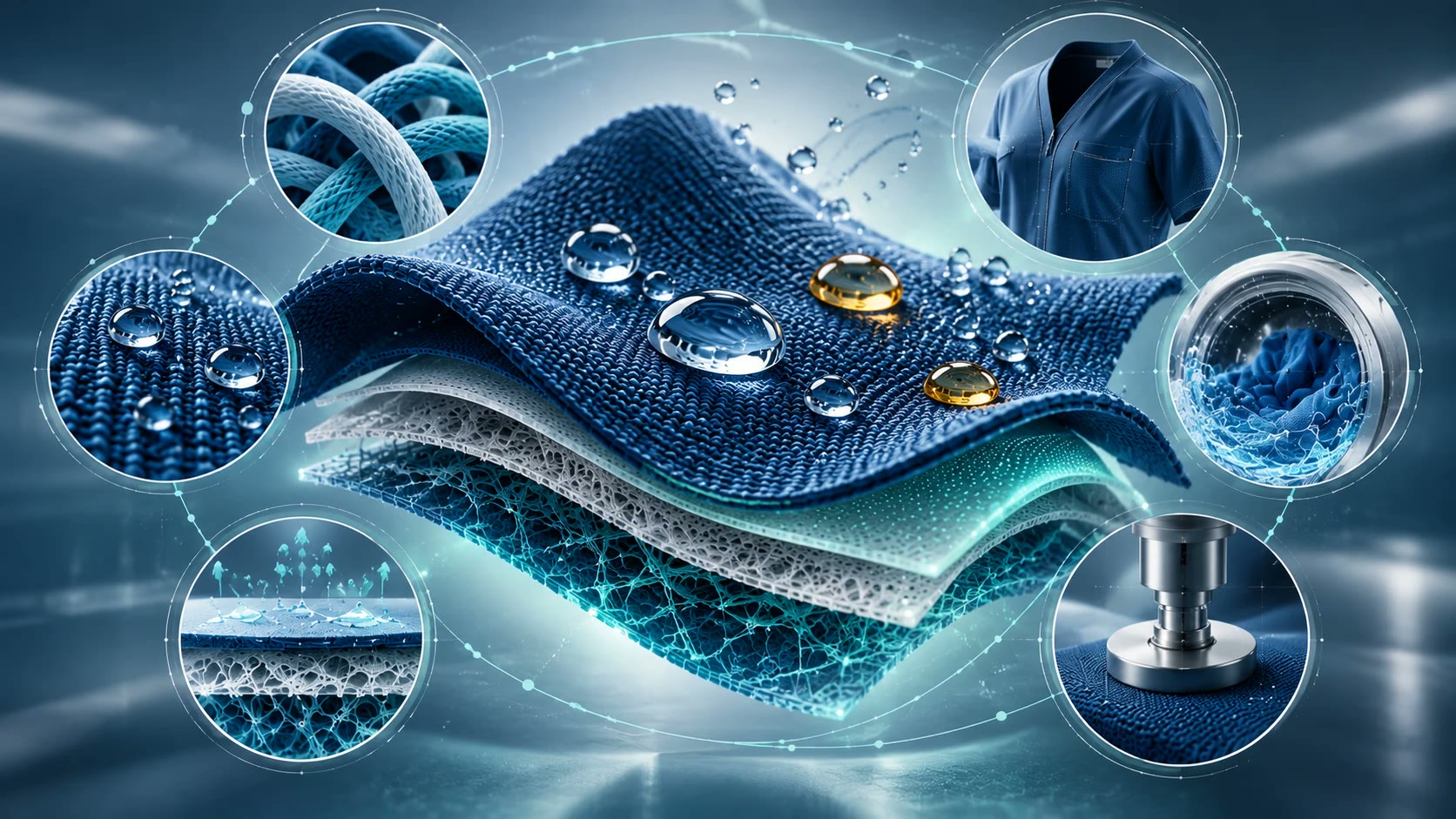
Functional claims are not material systems
Terms such as antimicrobial, water-repellent, stain-resistant, odor-control, and protective can describe a desired textile property. On their own, however, they do not explain whether that property is durable, comfortable, manufacturable, or appropriate for a given garment.
A surface finish may perform well on a new laboratory swatch yet behave differently after repeated laundering, abrasion, heat exposure, stretching, sweat, or extended wear. It may also interact differently with cotton, polyester, blended yarns, woven constructions, or nonwoven structures.
For HF Tex, the relevant question is therefore not simply “does a treatment produce an initial effect?” The more useful question is whether a functional property can be integrated into a material and garment system in a way that remains useful, testable, and manufacturable over its intended life. That distinction separates a marketing claim from an engineering program.
A four-part evaluation framework
A responsible functional-textile program begins with four connected elements.
1. Define the intended use
Performance requirements depend on where and how a garment will be used. A clinical scrub, emergency-response uniform, technical workwear garment, and field layer face different combinations of fluid exposure, laundering frequency, abrasion, thermal load, movement, and contact time. The first task is to define:
- The intended wearer and work environment.
- Likely exposure conditions.
- Expected laundering and maintenance cycle.
- Required comfort, breathability, and mobility.
- The performance trade-offs acceptable for that use.
2. Select the material architecture
The functional component is only one part of a textile system. The substrate, yarn construction, finish, curing process, garment pattern, seams, and care process can all affect the final result. HF Tex therefore evaluates material architecture as a connected system:
- Substrate: fiber composition, yarn, fabric construction, weight, and surface profile.
- Functional framework: finish, treatment, coating, grafting approach, or integrated additive.
- Application process: preparation, application method, curing, and quality control.
- Garment architecture: seam design, stress points, fit, and movement requirements.
- Care cycle: laundering, drying, maintenance, and expected service life.
3. Test before making claims
A textile property should be verified through a test plan that matches the intended function. Industry methods from organizations such as AATCC include procedures for accelerated laundering, finish durability, and antibacterial-finish assessment. These methods can help structure an evaluation; they do not establish that HF Tex has certified any product.
4. Assess manufacturability
A material direction can be scientifically interesting and still be impractical if it cannot be applied consistently, controlled at scale, or integrated into a realistic supply chain. Evaluation therefore includes reproducibility, process constraints, quality control, and the feasibility of work with contract mills.
Evaluation areas
A relevant test plan does not prescribe one universal method. It selects methods and acceptance criteria that match the intended material, garment, and use case.
| Evaluation area | Question to answer |
|---|---|
| Initial performance | Does the intended functional behavior appear on the defined substrate? |
| Wash durability | How does performance change after relevant laundering cycles? |
| Material integrity | Does the process affect tensile behavior, appearance, hand, or drape? |
| Wear comfort | Does the material remain breathable, flexible, and appropriate for extended use? |
| Safety and compliance | Are material selection, process inputs, and proposed claims appropriate for the intended market? |
| Manufacturability | Can the approach be reproduced at a realistic scale with defined controls? |
Why wash durability matters
Functional performance is often discussed at the point of application. In real garments, the more important question is whether that performance remains meaningful after repeated use and care.
For antimicrobial textiles, quantitative methods such as AATCC TM100 are commonly used to compare treated and untreated materials; testing can also be requested after laundering to examine the durability of a functional finish. For fluid repellency, stain release, abrasion resistance, and colorfastness, the same principle applies: the condition of the material after relevant use and care is at least as important as its initial result.
This is why HF Tex’s research direction emphasizes durable integration and practical evaluation rather than one-time surface effects.
From chemistry to usable apparel
A successful material is not necessarily a successful garment. An advanced functional framework may be scientifically interesting but still fail as apparel if it creates stiffness, compromises breathability, changes moisture handling, or cannot be applied consistently at manufacturing scale. Technical performance and garment ergonomics must be developed together.
HF Tex approaches this transition through a Material Technology Integrator model:
- Reviewing published material-science frameworks and candidate technologies.
- Defining relevant technical and operational use cases.
- Assessing substrate compatibility and finishing workflows.
- Considering application engineering and contract-manufacturing feasibility.
- Evaluating garment comfort, movement, seam performance, and service life alongside functional results.
A foundation for later research
This evaluation framework provides the foundation for the technical directions explored by HF Tex. Later materials updates may examine questions such as fluid repellency without intentionally added PFAS, wash-durable functional frameworks, and the transition from temporary topical finishes toward more integrated material architectures.
Those analyses should be read as research directions and industry context, not as claims that HF Tex currently sells a certified, medical, antimicrobial, or protective textile product.